automate the small stuff

Sunday morning
At friend messages me, “Want to get some coffee at 11:30?”
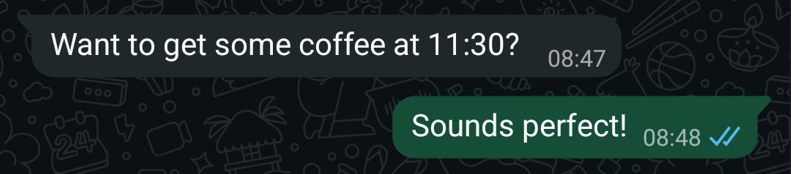
I look at my calendar. My schedule is free. “Sounds perfect!”.
Later on, around 11:00 AM, not long before I need to set off, I check my emails.
The subject “Your Huel order will be delivered today between…” stares back at me.

I begin to feel a small amount of anxiety. “Please be late afternoon”.
Taking the plunge, I tap to open the email.
Sod’s law. In plain text, it states “between 11:10 - 12:10”.
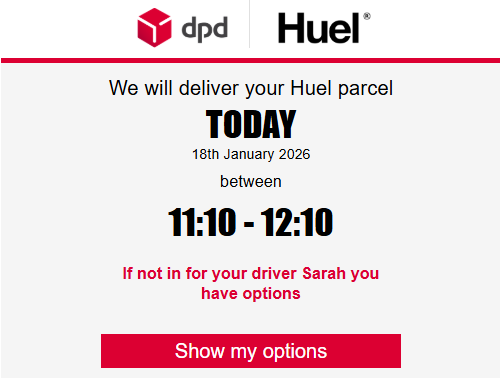
Not a big deal, except now I’m facing decision fatigue. What should I do?
Do I reschedule with my friend so I’m in to take delivery, but what if they have already left to meet me?
There are other options. Perhaps I could opt to leave the package in a “safe place”? Only, they’re not that safe. I don’t want to be worrying that my package is at risk of being nicked by a passer-by whilst I’m out.
Why didn’t I know about this sooner? I look at the email receipt time. “8:39 AM”.
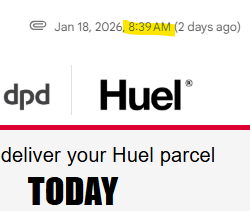
Ah, that’s on me. I could have checked my emails earlier.
Or, is it? I’ve been trying to build a habit of not looking at my emails first thing on weekends.
It doesn’t have to be like this
Such situations can be avoided.
What if the delivery slot was in my calendar before I checked my schedule?
Then we could have arranged a mutually suitable time and I could have avoided the cognitive load that came with the internal debate that followed.
How could it be in my calendar without me having to have had opened my emails first and added it myself?
That’s where automation comes in.
My user story
GIVEN I receive a delivery notification email from DPD
WHEN I view my Google calendar
THEN I see the delivery slot details as a calendar event
Small investment
What did I need to implement these requirements? Something that can:
- monitor my delivery notification emails from DPD
- parse and extract the key delivery details from relevant emails
- create and add an event in my Google calendar for the delivery slot
Whilst I would usually reach for Python, I chose n8n; a low-code automation platform that provides high level abstractions to build workflows quickly.
Why? I could do it with just 3 nodes.
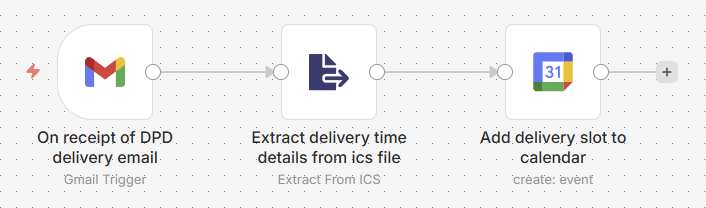
How long did it take? Less than 10 minutes, and most of that was configuring my Google Cloud console to enable the relevant APIs.
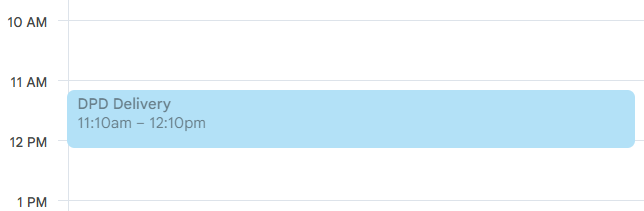
Now these delivery slots appear in my calendar seamlessly.
Big returns
You still might be asking yourself “Is it worth it?”.
After all, checking an email and making a calendar event only takes a minute.
In terms of time, it only takes 10 deliveries for me to break even.
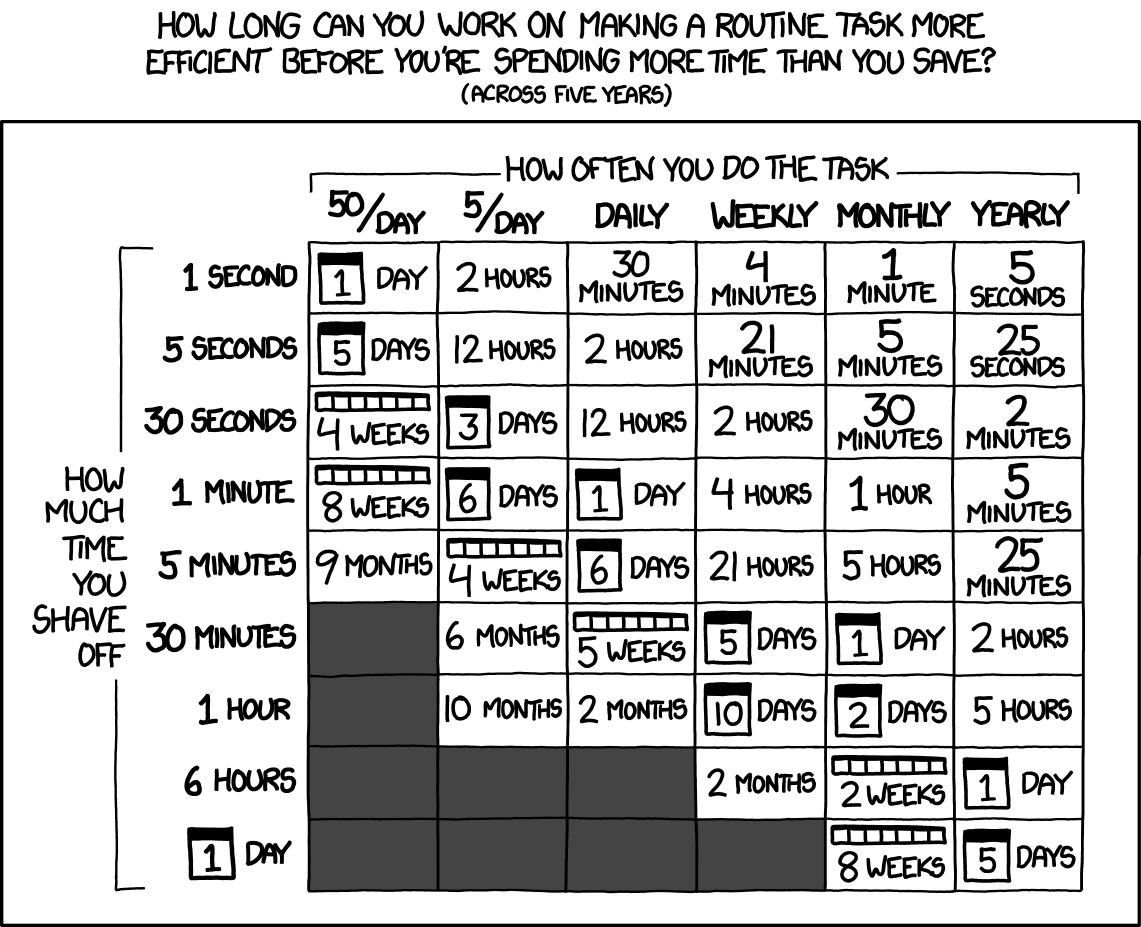
But, its not just about the time saved.
From the moment I ordered my Huel, I created an open loop: I needed to keep track of when that delivery was going to arrive; prompting me to check my emails more often than I would like to.
My mind is now free to contemplate the things that matter to me.
And when those double-booked mishaps happen. However minor it may be, the debacle to resolve it does cause unnecessary stress.
Now mistakes are far less likely to happen.
Imagine if that situation had been about a client on a new lead?
The need to reschedule could appear unprofessional and might be the difference between retaining or getting a new customer.
Sweat the small stuff.
The big stuff
So, should you automate the big stuff too?
Short answer:
Of course.
Long answer:
The workflows for big stuff will take longer to plan, assess, develop and validate.
You’re unlikely to get it right first time. So, it may take a number of iterations before you begin to see the value.
Comparatively, the small stuff could be automated today and the impact can be seen immediately.
TL;DR
Automate the small stuff. Reduce your cognitive load. It’s often simple to do. The ROI is surprisingly large.
Enjoy Reading This Article?
Here are some more articles you might like to read next: